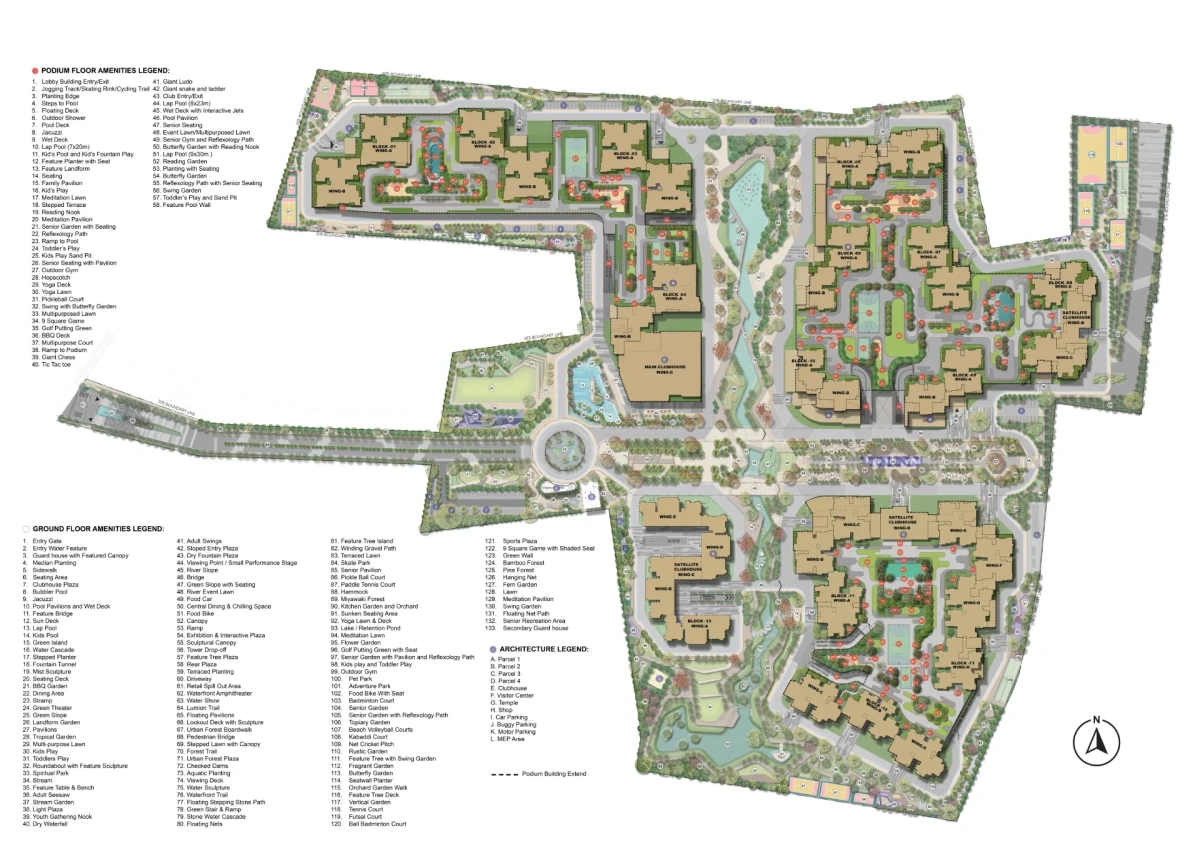
Master Plan

CKPC Heart of Harmony Master Plan & Site Design

The master plan of CKPC Heart of Harmony is built on a single deliberate trade-off: concentrate the built form into one efficient high-rise so that the ground can be given back as open, green, vehicle-free space. On a 1.7-acre site at Kudlu Gate, the project holds 84% of the land as open lung area. From a planning angle, Concorde Hennur keeps the reference local: internal roads, open-space placement, amenity access, and tower orientation all affect how the address will live after handover.

Site Design

CKPC Heart of Harmony Master Plan Logic

By keeping the tower's ground coverage tight, the plan frees the majority of the parcel for landscape, circulation and the outdoor amenity programme. The 84% open-space figure is the headline number that everything else in the design serves.

A single tower placed on a compact footprint, rather than multiple blocks, is the structural decision that defines the scheme. It maximises the open ground around the building, guarantees every residence at least two (and often three) exposed faces, and orients the building to capture natural light and the open city view.

CKPC Heart of Harmony master plan showing the single tower, open lung space and amenity zones at Kudlu Gate
Land Use

CKPC Heart of Harmony Land Use Breakdown

ElementAllocation / Detail
Total site areaApprox. 1.7 acres
Open lung space84% of site
Built footprintSingle tower (compact ground coverage)
Below-ground2 basement levels (parking + services)
Amenity levelsGround floor, 2nd floor, terrace clubhouse
Residences137 units, 6 per floor across 24 floors
Vertical landscapeOpen-to-sky sky gardens every 3 floors

How the Plan Works

Circulation, Below-Ground Infrastructure & Amenity Stack

Green belt and open-space design

The open space is the project's primary amenity. At the ground and podium level, the landscape is designed as a continuous green environment threaded with a nature trail, a reflexology path, seating plazas, campfire seating and an amphitheatre. Because the podium is vehicle-free, this entire ground experience is walkable and safe for children and older residents. The greenery then climbs the building through open-to-sky garden decks every three floors.

Road and circulation network

A 30-foot-wide entry and exit ramp carries traffic directly down into the two basement levels, so cars are parked below ground and the surface and podium remain free of vehicles. Three passenger lifts plus a dedicated service lift handle vertical movement, with the service lift routed separately so deliveries and maintenance never share the resident lobby.

How the amenity levels stack

  • Ground floor carries the social and work amenities — the banquet hall with kitchen and pre-function area, co-working pods, indoor games, the pet corner and a convenience-store provision — alongside the outdoor active programme.
  • 2nd floor functions as an intermediate amenity deck, lifting recreation above the street.
  • Terrace clubhouse crowns the tower with the wellness and signature recreation — the swimming pool with paddle and lazy pool, spa, sauna and steam room, ice bath, gym, pickleball court and multipurpose room.

The full amenity walkthrough is on the amenities page, and the unit-level layouts are detailed on the floor-plans page.
A Heritage-Inflected Design Philosophy

CKPC Heart of Harmony Master Plan — A Refined Cultural Brief

The design philosophy behind the master plan is editorial-heritage rather than generically contemporary. The decision to terrace the elevation with planted sky-garden decks every three floors is a vertical reinterpretation of the inner-courtyard tradition that anchors the South Indian home; the warm terracotta-and-bronze facade palette draws on the earth tones of regional craft and heritage architecture; and the sunlit corridor screens echo the jaali geometries that have softened light in Indian buildings for centuries. Translated through the language of a modern G+24 high-rise, these references give the site plan a refined cultural grounding that distinguishes it from the glass-and-aluminium uniformity of the corridor's volume product.

The orientation strategy reinforces this brief. A deliberate part of the master plan is how the tower is turned on its site: building orientation is set to draw abundant natural light into the homes and to face living rooms toward the open city outlook rather than toward neighbouring structures. On a corridor as built-up as Hosur Road, protecting the view and the light is a planning achievement, not a given — it requires the tower to be positioned and rotated so that the principal faces look outward to open sky and the cityscape. This orientation works in concert with the six-per-floor density and the zero-common-wall design so the orientation benefits reach nearly every residence rather than only a favoured few.

Sustainability and Below-Ground Infrastructure

CKPC Heart of Harmony Master Plan — The Engineering Beneath the Garden

The master plan's environmental logic is structural rather than bolted on. The 84% open ground improves rainwater percolation and tempers the heat-island effect that typically surrounds dense towers. Building orientation tuned for natural light, naturally lit corridors with sunlit screens, and higher floor-to-floor heights together reduce the daytime lighting and cooling loads. The vehicle-free podium keeps vehicular emissions below the living level. The recurring sky gardens add planted softscape through the full height of the building, supporting both microclimate and resident wellbeing.

Premium residential schemes of this calibre typically integrate rainwater harvesting, a sewage treatment plant for landscape reuse, and organic waste management at the back-of-house service level — infrastructure consistent with CKPC's people-and-planet design philosophy carried over from its Grade A+ commercial campuses. The two basement levels are the engine room of the project, absorbing resident and visitor parking, freeing the ground plane entirely, and housing the building's core services — water storage, pumping, electrical rooms and the back-up power infrastructure that delivers 100 percent power backup to every home. Concentrating these functions below ground keeps the visible environment clean and quiet, and positions the heavy services close to the structural base of the tower for the easiest maintenance and replacement cycles over the building's working life.

The Single-Tower Logic

CKPC Heart of Harmony Master Plan — Why One Tower Is the Right Answer

It is worth understanding why a single tower, rather than two or three lower blocks, is the right answer for this site. On a 1.7-acre parcel, splitting the built form into multiple blocks would consume far more ground coverage, eat into the open space, and force the blocks closer together — reducing privacy and the open outlook. A single slender high-rise concentrates the footprint, frees the maximum ground for landscape, and lifts more homes into the better light and views of the upper floors. It also simplifies the services strategy: one core, one set of basements, one set of lifts to maintain. The trade-off of a single tower — every home sharing one vertical core — is managed here by the generous lift provision and the low six-per-floor density, so the core never becomes a bottleneck.

A master plan is also a maintenance and ageing strategy that quietly shapes how the building reads ten years on. By pushing services below ground, keeping the podium vehicle-free, and distributing amenities across three levels rather than concentrating them, the plan spreads wear and avoids overloading any single zone in the development. The extensive landscape is designed to mature steadily over the years toward possession in 2030 and beyond, so the green environment deepens rather than degrades. The separation of resident and service circulation protects the finish quality of the resident lobbies over time. Finally, the arrangement of the basements, the wide ramp, fire-tender access around the tower, and the placement of services all respond to the sanctioned plan approved under the project's K-RERA registration — design decisions that satisfy the authorities as well as the buyer.

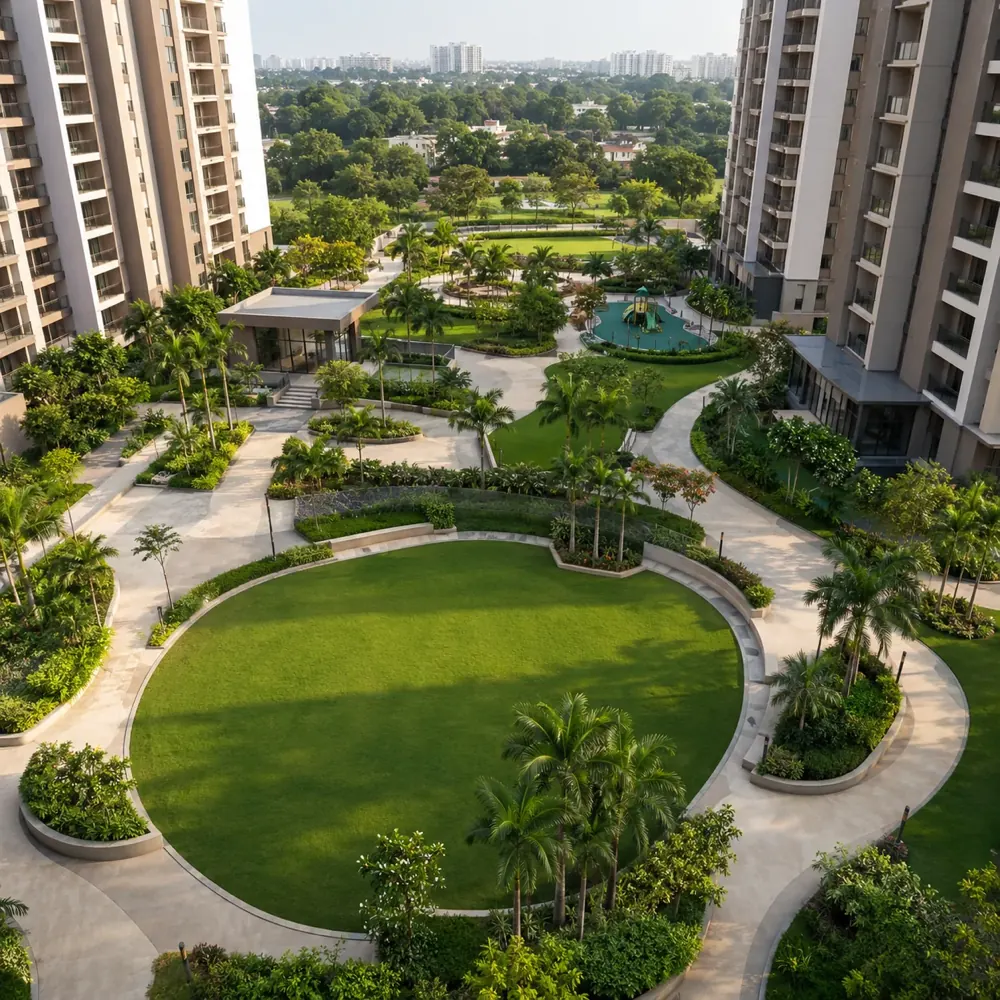
Landscaped vehicle-free podium at CKPC Heart of Harmony

Request the sanctioned master plan and the tower stack plan.

Want the full site layout?

Enquire Now View Amenities
Frequently Asked Questions

CKPC Heart of Harmony Master Plan - Frequently Asked Questions

The master plan holds 84% of the 1.7-acre parcel as open lung space, an unusually high proportion for a high-rise, achievable because the built form is concentrated into a single efficient tower rather than spread across blocks.

On a 1.7-acre parcel, splitting the built form into multiple blocks would consume far more ground coverage, eat into open space, and reduce privacy. A single slender high-rise concentrates the footprint, frees the maximum ground for landscape, and lifts more homes into better light and views.

Amenities are distributed across three heights: social and work amenities at the ground floor, an intermediate amenity deck on the 2nd floor, and the wellness clubhouse with the swimming pool crowning the terrace, so no single level is overburdened.

Two basement levels absorb resident and visitor parking and house the core services including water storage, pumping, electrical rooms and the back-up power infrastructure that delivers 100% power backup to every home, accessed by a single 30-foot-wide ramp.

Private open-to-sky garden decks recur every three floors, giving residents planted, partly shaded outdoor space close to their own homes without descending to the ground, and layering greenery vertically through the height of the tower.